Downspout flushing: where Apopka rain really goes
The gutter only collects. The downspout decides whether that water leaves the house or backs up behind the fascia.
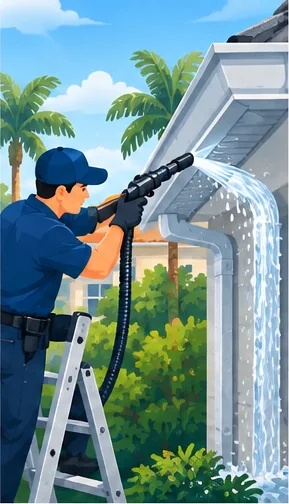
Why the downspout is the weak point
Debris travels downhill with the water and ends up at the outlet, which is a narrow opening compared with the trough above it. A handful of wet catkins and shingle grit is enough to form a plug.
Central Florida's wet season brings more than 7 inches of rain a month from June through September, against roughly 3 inches a month the rest of the year, per UF/IFAS. During those months a half-blocked downspout is tested daily.
What flushing involves
We typically feed water or compressed air into the downspout from the top, or runs a hose up from the bottom, until it flows freely. Elbows are the usual trouble spots, so a good visit checks them.
- Remove screens or strainers at the outlet.
- Run water through and watch for a slow drain.
- Clear the blockage and rerun until the flow is steady.
- Check where the water lands at ground level.
Buried drain lines are a separate service from ours; we clean and flush the downspouts and gutters.
What happens when water cannot leave
Water that backs up fills the trough, spills over the front, and runs down the siding or pools at the foundation. Water that backs up the other way soaks the fascia board and the soffit behind it, which are the parts of an eave that rot first.
Older wood-frame houses, such as some near the historic downtown core, can be especially vulnerable to this kind of rot.
Where the water should end up
After a flush, look at the discharge. It should land several feet from the wall and flow away from the house, not toward a slab edge. Extensions and splash blocks are cheap fixes that we can point out, though we do not do installation work. Start with a gutter clean-out if the troughs are full too.
Beat the next downpour
Request a free quote now and we will talk through what your roofline needs before the heavy rain returns.